TYPOLOGIES

Culture Tour

DIFFICULTY

MIN. AGE

Tour Overview:

This is an extraordinary route, a true epic overland journey that traverses the spine of Southeast Asia. It moves from the bustling streets of Hanoi through the mountain landscapes of northern Vietnam and Laos, then follows the Mekong south into Cambodia to the magnificent Angkor temples. Below is a detailed overview of this ambitious itinerary.

Itinerary in brief :

DAY DESTINATION MEAL CITIES
Day 1 Xin Chao “Hello” Vietnam Hanoi
Day 2 Exploring the Soul of Vietnam's Capital B Hanoi
Day 3 Hanoi – Halong B/L/D Halong
Day 4 Halong – Hanoi – Night train to Sapa B/Br Train
Day 5 Arrival Lao Cai – Sapa – Ta Van B/L/D Ta Van
Day 6 Ta Van – Giang Ta Chai – Lai Chau B Lai Chau
Day 7 Lai Chau – Dien Bien Phu B Dien Bien Phu
Day 8 Dien Bien Phu – Muang Ngoi B Muang Ngoi
Day 9 Muang Ngoi – Luang Prabang B Luang Prabang
Day 10 UNESCO Heritage B Luang Prabang
Day 11 Khouangsi Waterfall – Vang Vieng B Vang Vieng
Day 12 Discover Vang Vieng B Vang Vieng
Day 13 Vang Vieng – Vientiane B Vientiane
Day 14 Highlights of Lao’s Capital B Vientiane
Day 15 Vientiane – Pakse – Don Khone B Don Khone
Day 16 4000 Island Exploration B Don Khone
Day 17 Don Khone – Kratie B Kratie
Day 18 Dolphin Watching & Biking Tour B Kratie
Day 19 Kratie – Siem Reap B Siem Reap
Day 20 Grand Circuit & Banteay Srei B/D Siem Reap
Day 21 Angkor Highlight B Siem Reap
Day 22 Tonle Sap Lake & Countryside Explorer B Siem Reap
Day 23 Siem Reap – Phnom Penh B Phnom Penh
Day 24 Phnom Penh’s Past & Present B Phnom Penh
Day 24 Goodbye Cambodia, Vietnam and Laos B Phnom Penh

*B = Breakfast, L = Lunch, D = Dinner

Itinerary in details:

Today meet upon arrival at Hanoi International Airport. In Hanoi, first obtain your Vietnam visa on arrival. Clear Immigration and Customs and proceed into the arrival area. You will be met by our guide and transfer to your hotel. Enjoy the rest of your day at leisure.

Overnight in Hanoi.

Hanoi is a green city with its stylish French villas; it still exudes that old French charm and style. Its tree-lined boulevards, romantic lakes and French architecture allow us to step back in time to a quieter, more relaxed Vietnam. We visit the Ho Chi Minh mausoleum and Ho’s simple, yet impressive house on stilts, set in beautiful gardens. Then we view the One Pillar Pagoda and the ancient Temple of Literature, Vietnam’s first university. In the afternoon we visit the Ethnological Museum, one of the most interesting in Hanoi and then take an hour cyclo tour to discover the heart of Hanoi – the bustling Old Quarter – where the narrow streets buzz and bustle with the life of city. It is a shopper’s delight, with beautiful silks, linen, and Vietnamese artifacts. To finish off the day, we attend the performance of the famous Vietnamese water puppetry.

Overnight in Hanoi.

This morning, we leave Hanoi by road for Ha Long Bay by shuttle bus from the cruise, enjoying the timeless scenery of rice fields, water buffalo and daily life of the countryside. On arrival in Ha Long, we board a beautifully appointed wooden junk. A seafood lunch will be served as we cruise among the hundreds of islets in the Bay. Our cruise takes us to Sung Sot cave to witness a splendid sunset.

Overnight on boat.

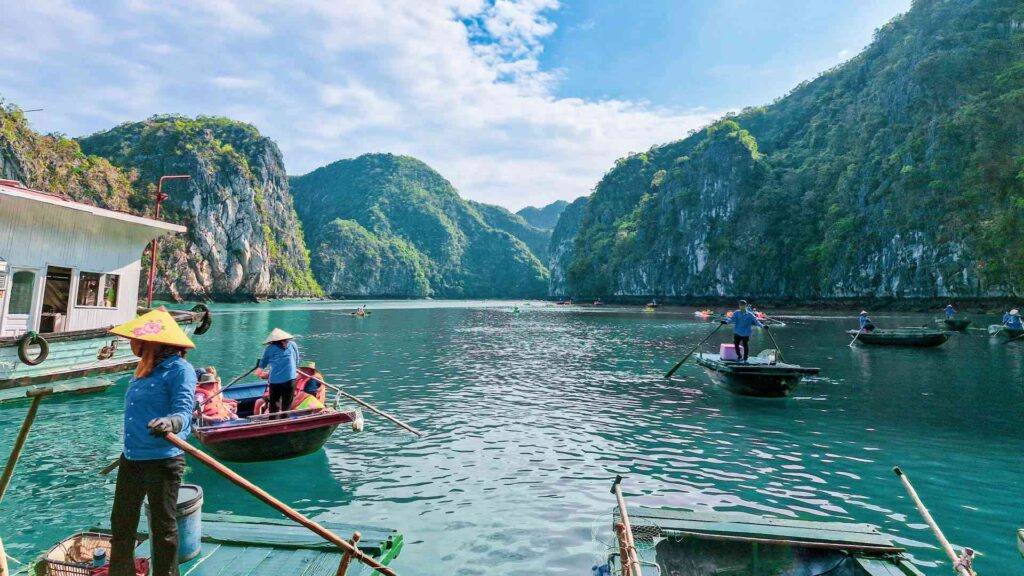
Early morning coffee and tea will be served on the sundeck followed by a Tai Chi class. We continue exploring magnificent Ha Long Bay. Change to a small motor or rowing boat to see the floating village. When we return to the junk, a sumptuous meal, combining Vietnamese and Western cuisine will be served. On leaving the cruise, we depart back to Hanoi by shuttle bus from the cruise.

Transfer to the station and night train to Lao Cai.

Overnight on Train.

We will arrive in Lao Cai around 6:00 am, where a private car will be waiting to take you on the final 40-kilometer journey up into the mountains to Sapa – the "Pearl of the Northwest."

This day is devoted entirely to a beautiful hike through the breath-taking scenery of the Sapa Valley, one of Vietnam's most iconic landscapes.

Your trek begins on Cau May Street, an ancient and lively thoroughfare in the heart of Sapa Town. From here, you will leave the bustle behind and step onto the trails that wind through the legendary rice terraces.

As you walk, you will witness a truly awe-inspiring sight: the rice terraces playing hide and seek with the morning mist. The mist drifts slowly across the hills, revealing glimpses of emerald-green paddies carved into the mountainside – a landscape that has been shaped by human hands for centuries.

Following a small track, you will descend toward the Muong Hoa River, crossing it on your way to Lao Chai, a traditional village of the Black Hmong people. Here, you will see women in indigo-dyed clothing, water buffalo grazing in the fields, and children playing along the dirt paths.

Past the colorful rice terraces – each terrace a different shade of green depending on the season – you will continue to the village of Ta Van Giay, home to the Giay ethnic minority. The houses here are built on stilts, with wooden walls and thatched or tin roofs, blending harmoniously into the landscape.

As you continue your trek along the Muong Hoa River, the trail will lead you to a small suspension bridge, approximately two kilometres from the settlement. Crossing it, you will feel the gentle sway beneath your feet and hear the river rushing far below.

On the far side, you can discover a fascinating collection of ancient rock carvings – one of Sapa's most intriguing and lesser-known treasures.

Your guide will share the legends and theories surrounding these mysterious stones, adding a layer of history and wonder to your trek.

As the sun begins to set behind the mountains, you will arrive at your homestay for the night. You will be welcomed into a traditional stilt house, where a local family will host you with warmth and hospitality.

Enjoy a home-cooked dinner featuring local specialties – perhaps thắng cố (a traditional Hmong stew), grilled river fish, and plenty of sticky rice. After dinner, you may join your hosts for a taste of corn wine (rượu ngô), listen to stories of mountain life, or simply relax on the wooden balcony as the valley falls into darkness, lit only by fireflies and a million stars.

Overnight at the homestay in the Sapa Valley.

Morning: Through Paddy Fields & Bamboo Forests

After a hearty breakfast at your homestay, you will bid farewell to your hosts and continue your journey deeper into the magnificent landscapes of the Sapa Valley.

Today's walk takes you through lush paddy fields – their brilliant green terraces cascading down the mountainsides like nature's staircase – and into bamboo forests, where the tall stalks sway gently in the mountain breeze and filtered sunlight creates dancing shadows on the forest floor.

Along the way, you will encounter a beautiful waterfall, its cool waters tumbling over moss-covered rocks into a crystal-clear pool. Pause here to catch your breath, take photographs, and perhaps dip your hands into the refreshing spray.

Midday: Giang Ta Chai Village – Red Dao & Black Hmong

Your path leads you to Giang Ta Chai village, a settlement nestled among the mountains and home to two distinct ethnic groups: the Red Dao and the Black Hmong.

The Red Dao women are easily recognizable by their striking red headscarves and intricately embroidered clothing. They are known for their skill in herbal medicine, and you may see them gathering leaves and roots from the forest – knowledge passed down through generations.

The Black Hmong, whom you met on the previous day, also inhabit this village. Here, you can observe the daily rhythm of mountain life: women weaving on backstrap looms, men carving tools, children tending to buffalo, and the ever-present smoke curling from kitchen chimneys.

Your guide will explain the distinct customs, languages, and beliefs of these two communities, who have lived side by side for centuries yet maintain their unique identities.

Afternoon: Transfer to Lai Chau

After exploring Giang Ta Chai, you will leave the trekking trails behind and transfer by private vehicle to the province of Lai Chau – a more remote and less-visited region than Sapa, known for its dramatic mountain scenery and diverse ethnic minority communities.

The drive itself is breathtaking, winding through high passes, terraced valleys, and small hamlets clinging to steep hillsides.

Late Afternoon: The Lü Villages of Ban Giang & Ban Hon

Upon arrival in Lai Chau, you will embark on a gentle walk through the villages of Ban Giang and Ban Hon, inhabited by the Lü (or Tai Lu) ethnic group – a people with deep cultural roots stretching across northern Laos, Thailand, China, and Vietnam.

After a full day of trekking, cultural discovery, and mountain driving, you will check into your hotel in or near Lai Chau. The evening is yours to rest, reflect on the day's encounters, and enjoy a well-deserved dinner.

Overnight at the hotel in Lai Chau.

Departure towards Dien Bien Phu on a road hidden under the tropical forests. Discovery of the local life of the red Hmong in the village of Sa Long then of the Khmu in Muong Cha.

Visit the Commander Castrie's Bunker (De Castries' Bunker), the French command post during the infamous 56-day siege of Dien Bien Phu in 1954. This underground bunker served as the headquarters for General Christian de Castries, the French commander. You will descend into the restored bunker, where sandbagged walls, communication equipment, and wartime maps recreate the tense atmosphere of those final days. Standing here, you can almost hear the echoes of strategic meetings and the distant thunder of artillery.

Next, you will visit the Dien Bien Phu Museum, a striking, modern building shaped like a soldier's helmet. Inside, an extraordinary collection of artifacts, photographs, weapons, and dioramas tells the story of the battle from both the Vietnamese and French perspectives.

From the museum, you will proceed to Hill A1 (Elaine), the most fiercely contested position of the entire battle. This strategic hill changed hands multiple times during the siege, and the landscape still bears the scars of war.

Your final stop of the afternoon is the Dien Bien Phu Military Cemetery, the final resting place for thousands of Vietnamese soldiers who gave their lives during the 1954 campaign. The cemetery is a serene and dignified space, with row after row of white gravestones, each bearing the name of a hero—or, for the many unknown soldiers, a simple inscription: "Liệt sĩ" (Martyr). A towering memorial statue stands at the center, honoring the courage and sacrifice of those who fought for independence.

Late Afternoon: Check-in & Rest

After a full and moving afternoon of exploration, you will check into your hotel in Dien Bien Phu City. The remainder of the evening is yours to relax, reflect on the day's discoveries, and enjoy a quiet dinner at a local restaurant.

Overnight in Dien Bien Phu.

Your day begins early with a nourishing breakfast at your hotel in Dien Bien Phu. Enjoy a final taste of Vietnamese coffee and prepare for a day of adventure across borders.

After breakfast, you will board a comfortable bus and journey westward through the dramatic mountain landscapes of north-western Vietnam.

You will arrive at the international border crossing between Vietnam and Laos. Here, you will complete your exit formalities from Vietnam and step across the threshold into a new country.

On the Lao side of the border, you will be warmly welcomed by your Laotian guide, who will accompany you for the remainder of your journey.

From the border, you will continue by bus to Muang Khoa, a small, sleepy town nestled along the banks of the Nam Ou River, a major tributary of the Mekong. The drive takes you deeper into Laos's lush, forested interior, passing through villages of wooden stilt houses, water buffalo grazing in emerald fields, and children waving from roadside gardens.

Upon arrival in Muang Khoa, you will stop for a traditional Lao lunch at a local restaurant.

After lunch, you will board a traditional long boat – a narrow, wooden vessel with a powerful motor at the stern – and begin your journey up the Nam Ou River. The river is your road; the current is your companion.

Your first stop is a small riverside village, home to one of Laos's many ethnic minority groups (likely Khmu or Hmong).

After approximately two and a half hours of gentle cruising, you will approach a striking sight: the Chinese-built dam plant, a modern structure that stands in contrast to the traditional landscapes around it. This hydroelectric facility harnesses the power of the Nam Ou River, generating electricity for local communities and beyond.

Your next stop is Sop Chem village, a tranquil settlement where the Nam Ou meets a smaller tributary. Here, you may see fishermen mending nets, children swimming in the shallows, and women washing clothes on flat stones by the water's edge.

After a full day of border crossings, winding roads, and river cruising, you will finally arrive at Muang Ngoi (often referred to as Muang Ngoi Neua), a car-free village perched on the banks of the Nam Ou. There are no roads into Muang Ngoi – only the river. This isolation has preserved its peaceful, unhurried charm.

Overnight in Muang Ngoi.

After breakfast, you will board your long boat once again and continue your journey upstream along the Nam Ou River. This morning stretch is perhaps the most beautiful of the entire voyage. The limestone karsts rise steeply from the water's edge, cloaked in dense green jungle. Mist clings to the mountaintops, and the river is calm, its surface reflecting the sky like polished jade.

Your first stop is a riverside village, home to one of the ethnic minority groups that inhabit the mountains and valleys of northern Laos – likely the Khmu, Hmong, or Tai Lue people.

After your village visit, you re-board your long boat and continue upstream. The river narrows in places, then widens again as you approach the confluence of the Nam Ou and the great Mekong River.

Here, carved into the base of a limestone cliff, lies the sacred Pak Ou Caves (Tham Ting & Tham Theung) – one of the most important pilgrimage sites in Laos.

Pak Ou Caves – The Sanctuary of a Thousand Buddhas

For centuries, Lao Buddhists have traveled to these caves to leave offerings of Buddha images. Today, over 4,000 statues – large and small, ancient and modern, made of wood, bronze, lacquer, and stone – fill the two main caverns.

Leaving the Pak Ou Caves behind, your long boat emerges from the Nam Ou and merges onto the Mekong River – the great artery of Southeast Asia, the "Mother of Waters" that flows through China, Myanmar, Laos, Thailand, Cambodia, and Vietnam.

The difference is immediate. The Mekong is broader, more powerful, more golden in color. The landscapes open up: rice paddies stretch to the horizon, dotted with palm trees and stilted villages. Distant mountains fade into layers of blue and grey.

Overnight at Luang Prabang.

An early start provides the fantastic opportunity to witness the captivating centuries old daily tradition of the alms giving ceremony, Tak Bat. Before sunrise, hundreds of saffron-clad monks file out from the old town's 35 temples to collect their daily alms from faithful residents.


Back to the hotel for breakfast, we visit the National Museum at the former Royal Palace displays a lovely collection of the artifacts reflecting the richness of Lao culture dating from the days of the early kings right through the last sovereign. The National Museum and the Central Market are not to be missed. We enjoy a short tour seeing the city’s oldest temple Wat Sene and Wat Xieng Thong, a significant monument to the spirit of religion, royalty, and traditional art. Later we’ll visit the impressive Wat Visoun, the oldest temple that houses many Buddha images. Next is Wat Aham, the ‘Monastery of the Blossomed Heart’ exudes serenity, and Wat Mai, the largest and most richly decorated of the temples in this city.

Evening, enjoy Luang Prabang night maket, offering a lovely variety of handmade textiles crafted by local and hill-tribe people, along with street food, knick-knacks and friendly banter.

Overnight in Luang Prabang.

After breakfast, travel south of town to the famous Kuangsi Waterfall; the turquoise color of the water with a backdrop of white limestone cliffs gives the waterfall a magical appearance. Depending on the season the water level varies, and you can be swimming in the beautiful pools. While there, you also will have the opportunity to visit the Sun Bear Reserve, a conservation center that rescues animals from the wildlife trade. We also visited Kuang Si Butterfly Park is a project that was initiated in January 2014 by 2 Dutch passionate people from Holland. The mission is to create a research center studying and publishing about Laos butterflies, host plants and preservation because of environmental issues in Laos. Finally, we visit Laos Buffalo Dairy is a socially responsible, sustainable farm, and social enterprise.


We catch an express train to Vang Vieng, a small and tranquil town nestled on a bend of the Nam Song River. After check into your hotel, free for your own time.

Overnight in Vang Vieng.

Today's tour combines all the activities that Vang Vieng is famous for: kayaking on the Nam Song River surrounded by rugged karsts and beautiful rural scenery and exploring limestone caves.

Your tour guide will take to to the north of Vang Vieng, where you'll firstly visit Tham Xang (Elephant Cave). This cave owes its name to a remarkable limestone formation and lies on the banks of the Nam Song River.

The nearby Tham Hoi Cave (Snail Cave) winds its way deep into the mountain. You'll float through the cave on inflatable tubes, exploring its long corridors and wonderful limestone formations. A pool of cool spring water lies at the mouth of Tham Nam (Water Cave), giving you a great opportunity for a swim.

Following a picnic lunch, trek to a Hmong village, passing through rice paddies and vegetable gardens. Return to Vang Vieng by kayaking down the Nam Song, taking you through idyllic scenes of rural life, with limestone mountains in the background.

Overnight in Vang Vieng.

Transfer to Vang Vieng train station for a journey down to Vientiane departing. You arrive in Vientiane, meet our driver and transfer to hotel.

Overnight in Vientiane.

After breakfast, departure to visit the colorful Thong Khan Kham market. There are many markets in Vientiane. There you will find all the foods that constitute the daily diet of Laotians but also all kinds of products (household appliances, jewelry, etc.). Dried red peppers are widely used in Laotian cuisine, particularly for macerating meat and fish. then visit the imposing Patuxay Monument. which is well known as a Triumphal Arch of Vientiane before continuing to the famous That Luang Stupa.

Continuation of the discovery of the city of Vientiane. We start with Wat Sisaket which is the oldest temple still standing in Vientiane. This amazing structure has remarkable frescoes and images of Buddha, then Haw Prakeo, the former royal temple of the Laos monarchy, which previously housed the famous Emerald Buddha Statue.

In the afternoon: we will visit to Wat Si Muang, which is very famous for its supernatural power. Then go to Buddha Park which takes around 45 minutes. Along the way, stop to take photos of the Friendship Bridge which was built by the Australian government in 1994 and connects Laos and Thailand. Arrive at Buddha Park and enjoy a walk in the park. Also known as XiengKhuan, this park is filled with over 200 Buddhist and Hindu statues. The concrete sculptures are bizarre, yet intriguing, sitting majestically in the peaceful grounds. The peaceful setting of the park on the banks of the Mekong contrasts radically with the somewhat eccentric works sculpted in 1958 by a Laotian shaman-priest-yogi. The concrete sculptures are bizarre, yet intriguing, sitting majestically in the peaceful grounds. Then you also visit the Laos-Thailand Friendship Bridge.

Return to Vientiane city centre. The rest of the day is free to take a stroll in charming, relaxing colonial neighbourhoods or you can enjoy a cup of coffee in shaded terraces while contemplating scenes of river life as the sun sets on the Mekong.

Overnight in Vientiane.

Breakfast in the hotel; met by your driver in the hotel lobby and then transfer to the airport for flight to Pakse; met by our guide & driver upon arrival and transfer to Wat Phu Champasak – to visit the fascinating pre-Angkorian ruins of Wat Phu. Wat phu is one of Southeast Asia's most dramatically situated temples. We have time to explore these intriguing Khmer ruins, which are perched at the base of Mount Phu Kao. Wat Phu is one of the Lao World Heritage sites recognized by UNESCO in 2001, this wonderful archeological site of Khmer civilization dates to the 5th century, predating the famous Angkor Wat in Cambodia. We continue our journey KHONG Island the largest island in the South Mekong River region known as the 4000 islands, one of the most scenic areas in Laos.

Overnight in Don Khone.

After an early breakfast, we explore Mekong with a slow motorboat down to Ban Khone (Khone Island), where you will see an array of relics from the French colonial era and retrace the old colonial past, including old French colonial buildings and the remnants of the first Lao railway with it’s locomotive. We continue discover the 4000 islands area by boat at our leisure to visit the Liphi waterfall, one of the most beautiful waterfalls marking the end of Lao border to Cambodia, also known as the Samphamith.

Overnight in Don Khone.

After breakfast, we drive to famous waterfalls of Khone Phapeng, the largest waterfall in South East Asia, known as Niagara of the east. Transfer to Cambodia-Laos border. Say goodbye to Laos guide and driver before crossing border to Cambodia.

Meet your Cambodian guide and drive for the charming Mekong port of Kratie, gateway to an encounter with the rare freshwater dolphins that inhabit the upper reaches of the Mekong in Cambodia.

We stop at Stung Treng to explore most beautiful part of the Mekong. Stung Treng, nestled along the mighty Mekong River and surrounded by verdant landscapes, offers an ideal setting for an unforgettable kayaking adventure. Kayaking offers a unique perspective on the region's natural beauty. It's a chance to connect with the mighty Mekong River, explore hidden wonders, and experience the thrill of adventure while being mindful of the environment.

Arrive in Kratie, check in at your hotel.

Overnight in Kratie.

After local breakfast, farewell our host and take ferry back to Kratie, where we walk through the central Market of Kratie where you will see the local trades and see some of the old colonial building which remain from the French colony. Before we leave Kratie, we might visit local rice whiskey production.

Visit the famous 100 pillars pagoda and learn its fascinating history as a place of pilgrimage for residents of Kratie.

We continue to Kampi, one of the many deep pools where the rare river dolphins gather to feed. We board a local boat and cruise out into the mighty Mekong for a chance encounter with these gentle creatures.If you like, we get on our bikes and do a tour of about 9 km. around the island heading north. We passed numerous typical Khmer houses on wooden supports. Let's not lose sight of traditional roof decorations. The numbers at the top indicate the year the house was built. The narrow paths here are perfectly designed for cycling, providing shade, and bringing us closer to the daily life of Koh Trong. Although some villagers may seem a little shy, the crowds of children and some older people will always give us their best smiles and give us the warmest welcome to their island with a hello.

Depart to Koh Ker, the former capital of the Khmer Empire between 928 and 944 A.D. Enjoy a simple packed or local lunch near the temple and continue to visit other ancient structures in the peaceful area. The remote archaeological site in northern away from Siem Reap and the ancient site of Angkor. It is a very jungle filled region that is sparsely populated. Only about two dozen monuments can be visited by tourists because most of the sanctuaries are hidden in the forest and the whole area is not fully demined.

On the way, we may stop to visit the sprawling jungle temple of Beng Mealea., Hindu temple, but there are some carvings depicting Buddhist motifs. Its primary material is sandstone and it is largely unrestored, with trees and thick brush thriving amidst its towers and courtyards and many of its stones lying in great heaps. Today the temple is largely overrun by vegetation and the stone walls are crumbling which adds to its charm in a unique way.

Overnight in Siem Reap.

After breakfast, we depart to Preah Khan Temple. It is located northeast of Angkor Thom and just west of the Jayatataka baray, with which it was associated. It was the center of a substantial organization, with almost 100,000 officials and servants. Next is Neak Poan, “the entwined snakes” is a small temple located on an island in the center of the now dry Jayatataka baray, a water reservoir 3,500-meter-long and 900 meter wide. Continue to Tasom offers some beautiful photo spots, especially the rear entrance where tree roots adorn the gateway.

We will visit the Landmine Museum where Mr. Aki Ra, a child soldier in the Khmer Rouge, has dedicated his life to helping those in need. Having spent most of his childhood fighting for the Khmer Rouge, Mr. Aki Ra was trained by the United Nations to detonate land mines; His fantastic work earned him a nomination for CNN Hero of the Year in 2010. They will stop at a local village to visit the families that are producing palm sugar.

Drive to the rural outskirt 35km from Angkor area to visit the smallest, but magnificent, Banteay Srei built in the 10th Century and dedicated to Shiva. The temple was the birthplace of Khmer classical style architecture and the bas-relief work is the best example of Khmer classical art remaining. The pink sandstone structure bears a series of striking and beautiful sculptures, lintels, pediments and friezes. Khmers say the temple must have been carved by women for the details are too fine for the hands of a man. On the way back stop at Pradark Village, where you will see the villagers making palm sugar, handicraft for selling to tourist. It’s a nice chance for you to see the local people living at the country side with their struggling for daily life.

Not to be missed is Banteay Samre: Its rose-colored sandstone walls are decorated with carvings and bas-reliefs, which are among the most accomplished Angkor has to offer.

Overnight in Siem Reap.


Dinner with Apsara Dance show at local restaurant.

For those travelers thirsting for cultural highlights of Cambodia, No visit to Cambodia is complete without attending at least one traditional Khmer dance performance, often referred to as 'Apsara Dance' after one of the most popular Classical dance pieces. Traditional Khmer dance better described as 'dance-drama' in that the dances are not merely dance but also meant to convey a story or message.


Overnight in Siem Reap.

We start very early in the morning so we can capture the iconic picture of the pre-dawn facing Angkor Wat temple. Sunrise at Angkor Wat can be a busy venue especially during the months of December, January, February and March.


After sunrise, we will explore the vast and rich of Angkor Wat temple, taking pictures at different angles, playing with light and shadows and capturing the most beautiful devatas carved in sandstone.


Next destination will be the Ta Prohm "Tomb Raider" fame. Ta Prohm has been abandoned to the elements, a reminder that while empires rise and fall, the riotous power of nature marches on, oblivious to the dramas of human history. Left as it was ‘discovered’ by French explorer Henri Mouhout in 1860, the tentacle-like tree roots here are slowly strangling the surviving stones, man first conquering nature to create, nature later conquering man to destroy.


Next, at the Golden Hour, will be the impressive Bayon temple with its 54 towers and 216 faces overlooking the defunct city of Angkor Thom. The final stop will be at one of gate of Angkor Thom to capture sunset over the moat.


Overnight in Siem Reap.

We will enjoy a boat ride on the Tonle Sap Lake. This is the largest permanent fresh-water lake in Southeast Asia and flows into Tonle Sap River, joining the Mekong in Phnom Penh. We will see a fishermen's "floating village" with floating schools, floating police station, etc. It is same as a big village floating on the lake, and the "village" move from place-to-place following water levels and current. We go to local pagoda, where you should change to clothes, we can get wet in as here we will experience the ceremony “Srouch Teok”, which roughly translates into “Water blessing”. A monk will chant in ancient Pali as he splashes water over us, washing away our sins and bad luck so we can start fresh and by being a good person can increase our good luck.

Go beyond the temples and dive into authentic Cambodian life with this extended quad bike adventure. Ride through scenic countryside, explore local communities, and experience culture, nature, and adventure—all in one unforgettable journey.

Ride away from the main roads and into the heart of rural life. You'll drive along dirt paths and narrow lanes shaded by palm trees, passing wooden stilt houses, vibrant gardens, and locals going about their day. The flat terrain makes for an easy, scenic ride suitable for all fitness levels.

Overnight in Siem Reap.

After breakfast, travel by road from Siem Reap to Phnom Penh by private vehicle and English guide. On route you will witness the everyday lives of Cambodians as you pass through interesting provincial towns, bucolic villages, and delightful scenery. This is no ‘freeway dash’ as you will often slow down to let cows and water buffalo wander across the road, pass horse drawn carriages, and school kids walking and cycling to/from school.

On route you may wish to stop off in Kampong Kdei, to look at Spean Pratos – an ancient Angkorian bridge.

Arrive in Kampong Thom, we visit Sambor Prei Kuk, which is dotted with hundred Pre-Angkor styled temples. The site, part of the Chenla Kingdom, includes an area of nearly 1000 acres enclosed by double walls, and hundreds of temples and towers; its construction predates Angkor Wat by several centuries. The road conditions are very poor, but the spectacular scenery, with a mixture of temples and forest makes the hardship all worthwhile.

Not far from Phnom Penh you may choose to stop at Skoun, also known as ‘Spiderville’ due to the deep-fried tarantula that is the local delicacy, are you adventurous enough to try one?

Upon arrival in Phnom Penh, check in and free for your own time.

Overnight in Phnom Penh.

Phnom Penh, Cambodia's vibrant capital city, offers a captivating blend of history, culture, and architectural marvels. A Phnom Penh city tour allows you to delve into the city's heart, exploring its iconic landmarks, hidden gems, and vibrant local life.


Morning Delights:

  • Royal Palace & Silver Pagoda: Be mesmerized by the grandeur of the Royal Palace, the official residence of the Cambodian King. Marvel at the intricate architecture and learn about Cambodian royalty. Next door, explore the Silver Pagoda, adorned with a gleaming silver floor and housing priceless Buddha statues.
  • National Museum: Immerse yourself in Cambodian history and art at the National Museum. Explore fascinating exhibits showcasing artifacts from the Angkor era and other periods, providing insights into the rich cultural heritage of Cambodia.


Afternoon Exploration:

  • Central Market (Phsar Thmey): Indulge in your senses at the bustling Central Market, a shopper's paradise. Wander through the labyrinthine alleys filled with stalls overflowing with local crafts, souvenirs, clothing, and Cambodian delicacies. Be sure to try your bargaining skills!
  • Next, we head to visit Wat Phnom: Ascend the scenic Phnom Penh Hill, where Wat Phnom, a Buddhist temple with a long history, sits atop. Enjoy panoramic views of the city and experience the tranquillity of the temple grounds.
  • We will enjoy a cruise for view sunset on the Mekong and Tonle Sap River (1 hour). Situated at the “Four Arms” where the Mekong meets the Tonle Sap River before splitting into two branches, Phnom Penh offers the ideal location to discover the mighty Mekong.


Overnight in Phnom Penh.

Transfer to Phnom Penh airport for departure to next destination. It’s time to say goodbye, we thank you for traveling with us and warmly welcome you to come again.

Services

What’s include :

TOUR COST INCLUDES:

TOUR COST NOT INCLUDES:

✅ Accommodation: 23-nights with daily breakfast in double / twin shared room

✅ 01 Night train (sharing berth 4 persons per cabin)

✅ Meals: at local restaurant (Foods only) as mentioned in program (B: Breakfast, L: Lunch and D: Dinner)

✅ Private Transportation: Airport transfers & Tours by air con. vehicles as per program.

✅ Private boat trip as mentioned in program.

✅ Entrance fees: Sightseeing and entrance fees as specified as mentioned in program.

✅ Private Tour Guide: Local English-speaking guide during tours as mentioned in program

✅ Flight ticket: Vientiane – Pakse (check in luggage 20kg and hand-carry 7kg).

✅ Train ticket (2nd class): Luang Prabang – Vang Vieng / Vang Vieng – Vientiane.

✅ All government taxes.

✅ 24hours supporting hotline.

✅ Cold water and towel during tours

❌ Vietnam, Cambodia & Laos Visa stamp fee

❌ All International air tickets.

❌ Other meal, drink, personal expenses, tip, Travel insurance,

❌ Early check-in & late check-out surcharge.

❌ International bank transfer fees (Banking fee is covered by the sender)

❌ Another thing not mentioned in included

GENERAL NOTICE:

  • Standard check-in time is 14h00 and check-out time is 12h00 at most of the hotels.
  • Arrival/Departure: Above prices are valid only for group of clients travelling together – arrival and departure with the same flight. Arrival/departure by other flight subject to supplement charge.
  • Program is subject to change without notice due to Airlines unexpected changes of schedule or flight unexpected cancellations.
  • There will be no refund or compensation applied due to force major which effect to visit program.
  • We reserve the right to adjust the prices at any time in the event of an increase of the fuel surcharge applied by airlines companies or any other transport companies.
  • Deadline for flight tickets: We will automatically issue flights 5 days after bookings is confirmed by us, please take note and come back to me within 5 days since booking is confirmed if you find clients don’t want to issue it.


Consultant/Emergency Contact:

EURASIE Travel “Best for the Best“ – Head office

#AC04, Street 59CW, Borey Sopheak Meangkul, Phnom Penh, Cambodia.

info@eurasietravel.com.kh / www.eurasietravel.com.kh


Hot lines:

+ Mr. Bonny: (+855) 12 608 108 (WHATSAPP)

    ” Possiamo dire che è stata la luna di miele perfetta. Abbiamo avuto la possibilità di entrare a stretto contatto con la gente locale, di vivere diverse esperienze molto interessanti e di visitare dei posti fantastici. Tutto era organizzato in maniera perfetta grazie anche al validissimo supporto del nostro corrispondente Roberto, che non ci ha mai lasciati soli. Da dietro le quinte ci ha assistito per tutta la durata del nostro magnifico viaggio di nozze, dandoci un valido supporto per qualsiasi cosa. Le guide e i drivers erano sempre puntuali, cordiali, molto disponibili e molto preparati. Difficile dire in una sola frase cosa ci sia piaciuto. In una sola parola: TUTTO. L’organizzazione pre e durante il nostro viaggio è stata ineccepibile. Non possiamo che ringraziare Roberto ed Eurasie per questa meravigliosa esperienza.”

    Erika e Andrea

    Tour Vietnam & Cambogia